
Spokane County Court Records After Arrest
After a Spokane County arrest, the jail roster and court record do different jobs. The roster is a Detention Services custody tool. It can show the booking number, intake time, bondable flag, total bond, and visible charge or hold text. The formal court record begins when the prosecutor files a charging document or when the court opens and tracks the case. That case record is where filed counts, hearings, court dates, warrants, release orders, amendments, dismissals, pleas, and dispositions are verified.
That split explains why a booking charge and a filed charge may not match. Arresting officers and agencies may enter an initial charge or hold when the person is booked. The Spokane County Prosecuting Attorney reviews reports and decides whether charges will be filed. Charges may be declined, reduced, amended, replaced, or filed in a different court than a reader first expected. Custody and booking details belong with Spokane County jail inmate records; booking photo questions belong with Spokane County jail mugshots.
Search Court Records After Jail Arrest
The local starting point is Spokane County Court Viewer. It provides county court case access paths and a disclaimer telling users to verify information against the official court record. For Superior Court criminal cases, the inspected defendant-name search required at least the last name and the first initial. District Court and municipal matters may follow different menus or court offices, depending on the charge and arresting agency.
- Use the jail roster first when custody, booking number, intake date, or initial charge text is needed.
- Open Spokane County Court Viewer and choose the court or criminal defendant search that fits the case.
- Search by defendant last name and first initial, or by case number when one is known.
- Open the matching case and review filed charges, hearing dates, warrants, bond entries, and status notes.
- Verify stale or conflicting data with the court of record before relying on the result.
The Court Viewer source is the local interface for Spokane County case lookup.
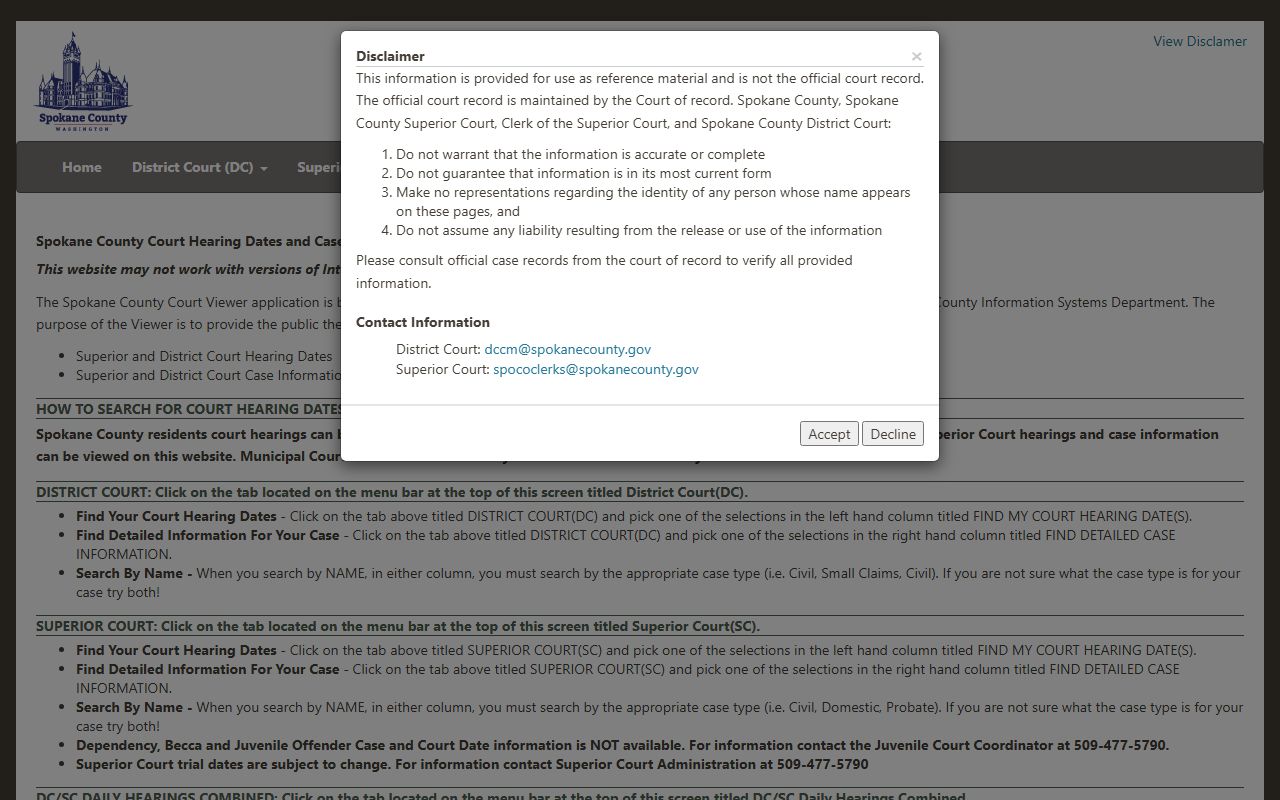
The court viewer is the bridge from custody information to the case record, but the court of record remains the final verification point.
Spokane County Court Search Fields
The Superior Court criminal name-search page has a smaller field set than broad commercial search tools. The Spokane research captured a required-name instruction and a short results table. This is useful when a person has been booked but the court case number is not yet known.
| Field Label | Type | Required | Notes |
|---|---|---|---|
| Last Name | Text | Yes | The page alert says at least the first letter of last name is required. |
| First Name | Text | Yes or partial | The instruction says last name plus first initial of first name. |
| Search | Button | Not applicable | Returns matching criminal defendant entries. |
| Result: Name | Table column | Not applicable | Defendant name. |
| Result: Case Number | Table column | Not applicable | Court case number. |
| Result: DOB | Table column | Not applicable | Date of birth field when shown. |
The Superior Court criminal name search source shows the defendant search form used for filed criminal cases.
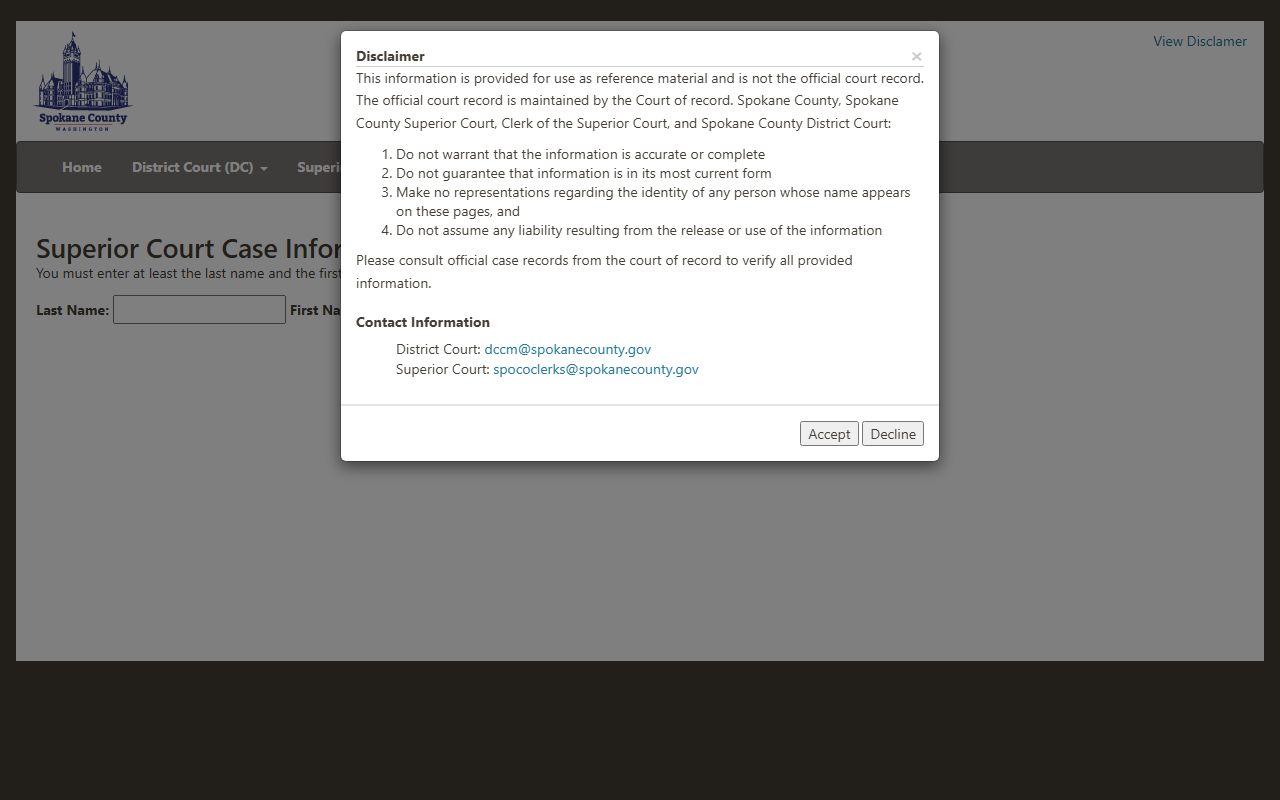
The field limits make accurate spelling important, and the case number should be saved once the right match is found.
Charges Filed After Spokane County Arrest
Spokane County court records after arrest are shaped by prosecutor review. Law enforcement submits reports after the jail event. The prosecutor decides whether charges will be filed and how the person will be notified. The county's Warrant or Summons page says defendants may receive a summons or an arrest warrant after the filing decision. Most cases use summons, while allegations involving violence may produce a warrant.
| Document | Common Use | What It Starts |
|---|---|---|
| Complaint | Often used in courts of limited jurisdiction and early criminal filings. | A formal accusation and court case path. |
| Information | Common Superior Court filing after prosecutor review. | Filed charges that replace or refine booking charge text. |
| Indictment | Possible but less common than prosecutor-filed information in Washington practice. | A criminal case based on grand jury action. |
The prosecutor's office also has communication limits. The Spokane County Prosecuting Attorney page says the office cannot discuss a represented defendant's case with that defendant, friends, or relatives. The county directs custody questions to the jail, court-date questions to the court, and legal questions to the defendant's attorney.
Spokane County Charge Status Records
A charge status is not the same thing as an arrest. The status shows where a filed count stands inside the court case. One count may be pending while another is dismissed. A charge can also be amended or reduced before plea, trial, or disposition. The court record is the place to verify those changes.
| Status | What It Means |
|---|---|
| Pending | The charge is filed and unresolved. |
| Amended | The filed charge was changed after the original filing. |
| Reduced | The charge moved to a lesser count or lower severity. |
| Dismissed | The court or prosecutor ended that count. |
| Conviction | Guilt was adjudicated by plea or trial, not merely alleged by arrest. |
Washington's Name and Case Search and court-date tools can help when a case crosses county visibility or when a statewide check is needed. Those tools warn that complete and current records come from the court of record or authorized court systems.
Bond Records After Spokane Arrest
Bond information may appear on both jail and court records, but it has to be read with care. Spokane County's roster includes a Bondable column and Total Bond. Values observed include YES, NO, and CALL. The county tells users to call the jail when the Bondable column says CALL. A NO value, federal hold, warrant, or court order can mean payment alone will not release the person.
| Release Type | Spokane County Notes |
|---|---|
| Cash bond | County bonds are posted at the right court during business hours; the jail accepts bonds when courts are closed. |
| Surety bond | Bond companies set their own collateral, fee, and paperwork requirements. |
| Personal recognizance | Release can be based on a promise to appear and court-imposed conditions. |
| No-bond hold | A legal hold, warrant, court order, or outside agency request may prevent release by payment. |
| CALL | The jail information line should be used before relying on visible bond data. |
The county bond page says checks and credit cards are not accepted for jail bond acceptance, and cash bonds must be in the full amount when the jail accepts them after court hours.
Warrants and Court Records After Arrest
Warrant access is a local caveat. Spokane County's Courts & Counsel material says warrant information is not given by phone. A person who wants to know whether there is a warrant for their arrest is directed to go to the Public Safety Building in person with proper ID. That means the page should not be treated as if Spokane County has a simple public sheriff warrant search.
A warrant can still be visible through the path it creates. If the person is arrested and booked, the jail roster may show custody, charge, hold, or bond signals. If the prosecutor files charges, the court case may show warrant, summons, hearing, or failure-to-appear activity. WADOC warrant tools apply to state DOC supervision or prison-related issues, not ordinary Spokane County bench warrants.
Note: Spokane County warrant checks require in-person ID when the county has not made phone or online disclosure available.
Charges vs Convictions
Court records after a Spokane County arrest may show an accusation long before any final result. A charge is what the state alleges. A conviction is the outcome after a guilty plea, trial verdict, or other adjudication. This difference is critical for employment, housing, licensing, and any formal decision-making context, where regulated background-check rules may apply.
| Point | Charge | Conviction |
|---|---|---|
| Stage | Accusation after filing. | Final guilt finding by plea or trial. |
| Proof | Based on probable cause and filing standards. | Requires plea or proof beyond a reasonable doubt at trial. |
| Can change? | Yes, it may be amended, reduced, or dismissed. | Changes only through court action such as appeal or vacation. |
| Where verified? | Court case record and filings. | Court disposition record. |
Sealed vs Expunged Records
Washington access law is not the same as casual web visibility. Chapter 42.56 RCW governs public records requests unless a specific limit applies. Chapter 10.97 RCW governs criminal history record information. Court sealing, vacation, or other relief depends on the record type, charge, case result, waiting period, and court order. A dismissed charge does not make every online reference vanish by itself.
| Point | Sealed | Expunged or Vacated Context |
|---|---|---|
| Visibility | Public access is restricted by court order or rule. | The record or conviction status may be legally changed when eligible. |
| Agency access | Courts and justice agencies may retain limited access. | Access depends on the order and Washington law. |
| Needed step | File in the court that controls the case. | Use the correct Washington relief process for the case type. |
| Jail record impact | Jail records may still be confidential under RCW 70.48.100. | Separate agencies may need separate legal direction. |
For a Spokane County arrest, the most reliable path is to identify the court case, confirm the disposition, and then use the court's process for sealing, vacation, or access limits when the law permits it.
Restricted Spokane County Court Records
Not every record tied to an arrest is open in full. Juvenile matters, sealed records, confidential victim information, protected addresses, medical information, jail management records, and active investigation material can be withheld or limited. RCW 70.48.100 is especially important for jail records because it says the jail register is public while records of persons confined in jail are held in confidence with limited exceptions.
Use court records for filed charges, dates, and dispositions. Use the jail for custody status and bond instructions. Use the Public Records Office, sheriff disclosure portal, or court clerk for copies when a record is not visible online. That routing avoids mixing the booking record with the court case record.
Important: Do not use informal court or custody lookups for credit, employment, housing, insurance, or other FCRA-covered decisions.